



When an AI-assisted memorandum, contract draft, or court filing reaches a client, the model does not sign it. A qualified partner or lawyer signs it.
The algorithm holds no professional standing, owes no custodian duty, carries no professional indemnity insurance, and cannot be struck off a roll. Professional responsibility stays with the lawyer and the firm.
In private practice across Europe, that responsibility is rarely tested in court first. It is tested in routine commercial situations:
- A corporate client queries an invoice narrative or invokes Outside Counsel Guidelines (OCGs) to inspect how generative AI was used on an instruction.
- A practice head conducts cold file review across teams.
- A professional indemnity insurer reviews supervisory controls during annual policy renewals.
- A client questions the factual basis or case citations in a formal advice note.
When these reviews happen, the question is not whether the firm used automated software. Corporate legal departments in Europe expect technological efficiency. The decisive question is: can the firm show how the work was prepared, what Ai tools were used and who verified the output, and most importantly how client confidentiality was preserved?
If answering that question requires IT forensic teams to search browser histories, check proxy logs, or legal professionals to reconstruct drafting decisions from memory weeks later, the firm cannot defend its position.
Why a Written Policy on Its Own Is Not Enough
When generative AI tools entered legal offices, most firms responded with standard administrative measures: they updated the risk register, circulated an acceptable-use policy, required legal professionals to confirm receipt, and ran an annual seminar.
While a written policy sets expectations, it does not govern daily work. A policy tells lawyers what they ought to do. It cannot see what they actually do when facing a tight deadline on a cross-border transaction.
Legal professionals who turn to unapproved tools do not do so to break rules. They do so because consumer tools help them finish work on time. A static document saved on an intranet cannot monitor data leaving a web browser, cannot stop an accidental disclosure of confidential matter details, and provides no evidence when a client audits internal controls.
To move from passive intention to active risk management, firms must introduce practical controls directly into legal workflows. Recording decisions on the matter file is the core.
Technical System Logs vs. a Defensible Matter Record
Legal IT teams often confuse raw technical logs with proper legal records. They assume that because network firewalls and proxy servers track connections to AI services, the firm is covered.
In practice, exporting raw system logs creates fresh data-protection liabilities without answering professional supervision questions.
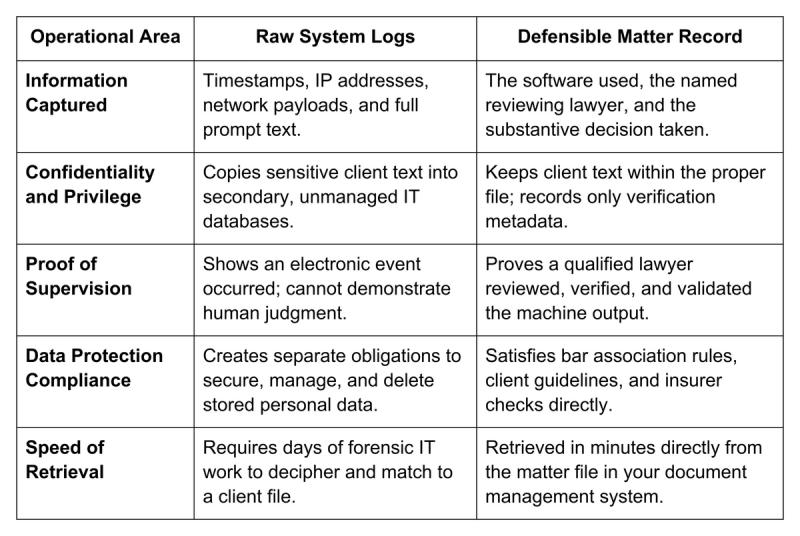
Saving every prompt creates a separate, uncontrolled store of client information. If a firm logs all text typed into an AI assistant, it creates a second copy of sensitive matter data outside the primary document management system (DMS). Under European and UK data protection rules, that second copy requires its own retention schedule, security controls, and deletion process under GDPR Article 5(1)(e).
A defensible legal record does not duplicate client material. It records the lawyer's professional decision.
The Three Elements That Belong on the Matter File
Whenever an automated tool contributes to client work, the matter file must record three clear points: the Tool, Reviewer and Decision.
1. Tool
The file must identify the specific software used. Writing that "AI was used for research" is not sufficient. The record must state:
- The exact software application and version used, confirming it is an approved enterprise system rather than a consumer web service.
- That the software operates under commercial terms guaranteeing that entered material is not stored to train foundational models.
- That the platform complies with the client's Outside Counsel Guidelines regarding permitted technology.
2. Reviewer
Every piece of machine-generated text must link to an individual lawyer. Automated software cannot carry professional responsibility.
The file must name the qualified lawyer who reviewed and checked the draft. This satisfies the duty of supervision set out by European national bar associations and the Solicitors Regulation Authority (SRA) in the UK.
3. Decision
The most critical part of the record is proving that the lawyer exercised independent professional judgment. The file must note whether the draft was:
- Accepted with minor adjustments: Confirming that all statutory references, case citations, and factual claims were checked against primary legal databases.
- Substantially rewritten: Noting where the machine draft missed legal nuance, misapplied procedural rules, or misunderstood local jurisdictional facts.
- Discarded: Recording instances where the software invented non-existent legal authorities, gave flawed reasoning, or introduced irrelevant facts.
The 5-Minute Matter File Test
Select one live or recently closed matter where your legal teams used an online AI tool.
Can your team produce the tool name, the reviewing lawyer, and the signed verification record within five minutes?
If your firm relies on memory, unsaved browser tabs, or scattered emails, your supervision process is vulnerable.
Regulatory Realities Across the EU, and Nordics
Keeping a clear record is not mere administrative box-ticking. It is the main way a firm proves compliance with legal service regulations across Europe.
The Nordic Region: Advokatsamfundet, Professional Secrecy, and Trust
In Denmark, Sweden, and Norway, professional client confidentiality (advokathemmelighed / advokattystnadsplikt) forms the foundation of professional legal rules. Guidance from bodies such as the Danish Bar and Law Society (Advokatsamfundet) and the Swedish Bar emphasises that technological tools must never compromise client secrecy or the independence of the advocate.
Nordic corporate clients and public bodies place high value on institutional trust, data privacy, and transparency. In cross-border disputes and advisory work, courts and arbitration institutes (such as the SCC Arbitration Institute) examine the credibility and provenance of submissions. A firm that maintains a transparent, auditable matter record can immediately prove that no client text was exposed to public training engines.
The European Union: GDPR and the EU AI Act
Across EU Member States, statutory legal duties operate alongside regional regulations:
- Data Minimisation (GDPR Article 5): Storing large amounts of unmanaged prompt data breaches data protection principles if personal information from court bundles sits permanently in temporary system caches.
- EU AI Act Deployer Rules: The EU AI Act places obligations on organisations deploying AI systems, including requirements for workforce AI literacy and operational oversight.
- CCBE Guidance: Standards from the Council of Bars and Law Societies of Europe (CCBE) maintain that using automated drafting tools requires the same level of oversight as delegating work to a junior paralegal or external clerk.
The United Kingdom: SRA Standards and Regulations
In the UK, the position of the Solicitors Regulation Authority is explicit. Under the SRA Code of Conduct:
- Paragraph 3.1: Solicitors must keep their professional skills up to date, including understanding the operational risks of legal software.
- Paragraph 4.2: Firms must protect client assets and confidentiality, ensuring third-party technology providers do not compromise legal professional privilege.
- Paragraphs 5.1 and 5.2: Firms must maintain effective management systems and properly supervise all legal work.
Making the Record Part of Daily Work
Lawyers are paid for their strategic advice, analysis, and advocacy, not for filling out administrative forms. If recording the use of modern tools requires manual spreadsheets, lengthy checklists, or separate memos for every task, lawyers will work around the system and turn to unmonitored personal devices.
Record keeping must happen naturally within daily work processes.
Modern legal software connects directly to the web browser and drafting software. When a lawyer uses an approved system:
The System Recognises the Task: The software automatically notes the tool and the relevant practice group rules.
Safety Controls Block Data Leaks: Client matter numbers, company references, and personal details are flagged or removed before text leaves the computer.
Review Prompts Appear in the Workflow: Once text is generated, a quick prompt asks the lawyer to confirm that they checked and verified the work.
The Details Are Saved: A simple record containing the tool name, the reviewer, and their decision is saved to the central audit store without duplicating the underlying client advice.
This approach changes compliance from an end-of-matter scramble into a smooth, automatic routine. It gives IT complete visibility, gives risk partners reliable evidence, and gives fee earners the freedom to work quickly.
Frequently Asked Questions
Does every simple research question need a formal file entry?
No. Firms distinguish between general background research, such as checking public legislation or industry summaries,and matter-specific drafting. A formal file record is required whenever automated tools process client facts, touch proprietary matter documents, or contribute directly to advice sent to a client.
Why is storing complete prompt text risky?
Keeping full text histories creates an unmanaged second store of client information. This extra data increases security risks, makes it harder to comply with data deletion requests under privacy legislation, and creates problems during document disclosure in court proceedings. Recording the administrative details of the review is safer and legally sound.
How do file records help with professional indemnity insurance?
Insurance underwriters pay close attention to technology risks in legal practice. Firms that demonstrate active controls and clear supervision records are in a stronger position to secure good terms and avoid broad exclusions regarding automated tools.
Who carries liability if an automated document contains a serious mistake?
The signing lawyer and the firm remain solely responsible. Regulators and courts do not accept software errors as an excuse. Demonstrating that the firm maintained proper standards of human review is vital to defending against negligence claims and disciplinary action.
How quickly can a firm set up this type of tracking?
Unlike large changes to practice management systems, web-based oversight tools can be set up in days. Firms gain real-time visibility and record keeping across their whole team without writing custom software or disrupting billable work.
Support Innovation with Complete Confidence
Using modern AI tools in a law firm does not mean compromising professional standards or risking client confidentiality. By keeping an automated file record that captures the tool, the reviewer, and the professional decision, your firm can encourage modern working practices while maintaining a defensible legal position.
Book a Free Demo for Your Firm
Discover which tools are currently running across your firm and put defensible record keeping in place.
Or download the complete framework: AI Governance Checklist for Law Firms