



Lawyers across Europe are already using generative AI to summarise disclosure bundles, draft skeleton arguments, and benchmark contract terms. While some of this activity may take place inside firm-sanctioned enterprise sandboxes. A significant portion, however, runs across unvetted browser extensions, personal ChatGPT accounts, and third-party drafting tools that the firm’s IT committee has never had the opportunity to evaluate let alone approve.
For leadership of the firm whether you sit as Managing Partner, Chief Operating Officer, or Chief Information Officer this dynamic creates a strategic bind. Your statutory duties have not changed: client confidentiality, legal professional privilege (LPP), and the obligation to stand behind your legal work remain absolute under EU national bar rules.
What has changed is the ease with which sensitive matter data can leave your control. A single paragraph pasted into an unsanctioned AI service or tool can breach client Outside Counsel Guidelines (OCGs) within seconds.
Yet the solution is not to lock down your systems. When forward-thinking European law firms look at AI, their ambition is not reduction, it is controlled expansion. They want to enable their teams to work faster, but they require the operational confidence that client files are protected and that their governance posture is provable.
Achieving that posture does not demand an 18-month IT overhaul. It requires shifting from static policies written on paper to active, point-of-use AI governance.
Why a Written AI Policy on Paper Fails
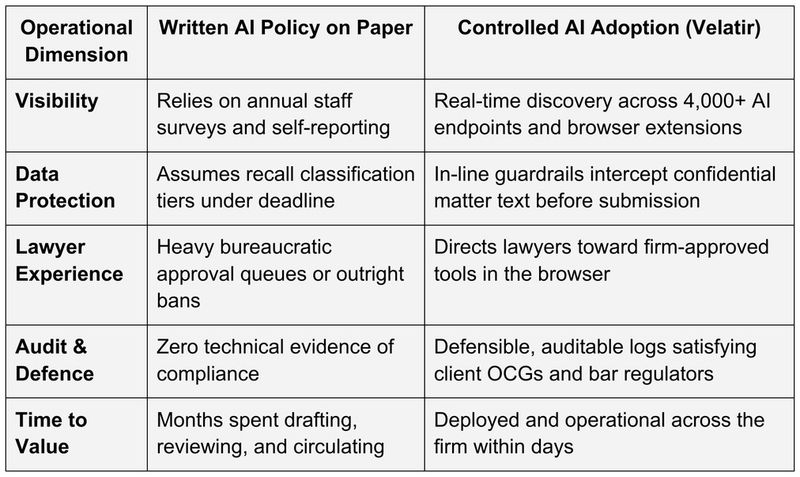
When generative AI tools entered law offices, the default institutional reaction was administrative: draft an AI policy, circulate it to partners, require a signature, and schedule an annual compliance seminar.
While a written policy establishes baseline expectations, it is fundamentally disconnected from day-to-day legal workflows. A policy outlines what we should do; it cannot observe what they actually do when working against a midnight deadline or closing a complex cross-border transaction.
Lawyers under pressure do not circumvent policies out of malice. They do so because consumer AI tools solve immediate workflow bottlenecks. A static PDF stored on an intranet portal provides no real-time visibility, stops zero data leaks, and creates no defensible record when a corporate client or professional indemnity insurer audits your safeguards.
The Four Pillars: SEE, PROTECT, ENABLE, PROVE
Governing AI effectively while encouraging innovation requires an operational model built specifically for professional services. Rather than relying on rigid perimeter firewalls, mid-sized law firms manage AI through four continuous stages: SEE, PROTECT, ENABLE, and PROVE.
- SEE ➔ Uncover shadow AI & active tools across practice groups
- PROTECT ➔ Safeguard legal privilege & matter files at the boundary
- ENABLE ➔ Guide fee-earners to approved tools at the point of use
- PROVE ➔ Produce audit trails for clients, insurers & regulators
1. SEE: Uncover the Real AI Footprint
You cannot govern what your IT team cannot see. Most leadership teams assume their AI exposure is limited to Microsoft 365 Copilot or an enterprise ChatGPT license.
Velatir’s benchmark data reveals a very different operational reality:
Mid-sized European businesses typically run 20 to 40 distinct, unvetted AI tools across their network.
These tools rarely enter through central IT procurement. They arrive as Chrome extensions that summarise case law, free PDF utilities that translate foreign witness statements, or transcription engines that process client calls.
Gaining visibility means establishing a real-time inventory of every AI service touching the firm's network, identifying:
- Which specific AI tools and paralegals have access on live matters.
- The data processing terms of each tool (e.g., whether prompts are retained to train public foundational models).
- The jurisdiction in which user prompts and outputs are hosted.
This discovery phase should not require months of endpoint software development. Velatir’s Modern AI governance monitors over 4,000 AI services out of the box, giving leadership an accurate baseline of the firm’s shadow AI within days.
2. PROTECT: Safeguard Privilege and Client Data
Legal professional privilege and client confidentiality are binary: once matter information is disclosed to an unvetted third party without confidentiality protections, privilege can be permanently compromised.
Public generative AI services operate on distinct terms of service. Free or consumer-grade subscriptions frequently reserve the contractual right to log inputs, use user prompts for model training, or allow human review of flagged queries. Pasting an unredacted draft share-purchase agreement, patent application, or litigation strategy into such a tool constitutes an immediate data transfer to an external processor.
Effective protection requires technical guardrails that sit between the user and the web. These guardrails identify and intercept sensitive matter identifiers before they leave the browser:
- Client and Matter Numbers: Preventing queries tied to sensitive, confidential transactions.
- Personally Identifiable Information (PII): Enforcing GDPR compliance by stripping personal identifiers from research prompts.
- Privileged Text and Work Product: Intercepting legal opinions, settlement figures, and sensitive internal strategy documents.
Crucially, this protection must function without creating a duplicate internal repository of client documents, avoiding secondary data liabilities.
3. ENABLE: Guide at the Point of Use
Blanket bans fail in professional services environments. When management attempts to block generative AI tools entirely,adoption does not cease; it simply migrates to personal laptops, smartphones, and domestic networks outside the firm's perimeter.
The objective of an AI governance framework is to make the safe path the easiest path. Rather than presenting users with an error screen or a firewall block, modern point-of-use governance introduces intelligent prompts and reminders:
- Contextual Redirection: When navigating to an unapproved public consumer model, an in-browser prompt explains the policy risk to the user and provides them a one-click redirect to the law firm’s approved enterprise tools.
- Pre-Flight Redaction: If a lawyer attempts to paste text containing sensitive client identifiers into an approved tool, the system highlights the risk and suggests instant redaction or anonymisation.
- Tiered Tool Permissions: Practice groups handling public corporate filings can be granted wider latitude, while restructuring, IP, and M&A teams work under stricter, automated data-handling parameters.
By embedding guidance directly into the workflow, the firm moves away from punitive controls and fosters continuous, safe adoption and enhanced productivity.
4. PROVE: Build Defensible Governance for Clients and Regulators
Adopting AI responsibly is no longer just an internal risk discussion; it is a market requirement. Corporate clients, general counsel, and professional indemnity insurers routinely demand evidence of technical safeguards within outside counsel audits.
Simultaneously, the regulatory bar across Europe has solidified:
- EU AI Act & GDPR: Deployers of AI systems must ensure data minimisation, maintain oversight, and demonstrate literacy and governance over tools handling personal data.
- Council of Bars and Law Societies of Europe (CCBE) & National Bars: Professional standards across the Nordics, Germany, and the Netherlands mandate strict supervision of third-party processing tools to protect professional secrecy.
- UK Standards (SRA & The Law Society): Regulators require firms to monitor outsourced technology risks, safeguard client assets, and account for the accuracy and integrity of automated work products.
A paper policy provides no verifiable proof of compliance. An active governance platform provides an immutable audit log recording:
- The exact service accessed.
- The operational risk profile of the transaction.
- The specific safety controls triggered and confirmed.
- The designated fee-earner responsible for human review of the final output.
This audit trail satisfies institutional client security questionnaires immediately, without burdening fee-earners with manual compliance reporting.
Frequently Asked Questions
Do you know which AI tools your teams are using today?
Most legal executives do not have complete visibility. Unsanctioned use typically involves free web tools, transcription plug-ins, and browser assistants added directly by individual lawyers seeking to accelerate everyday tasks.
Can entering client material into a public tool waive legal professional privilege?
Yes. If information is entered into a tool whose terms of service permit employee review, model retraining, or transmission across unvetted third parties, statutory confidentiality can be compromised, opening the firm to privilege challenges.
Why is a written AI policy insufficient for client audits?
Corporate clients increasingly ask for technical verification rather than policy declarations. A written document proves intent; it does not prove that sensitive files were not submitted to unvetted cloud systems during live instructions.
Should law firms ban consumer AI platforms entirely?
Bans generally lead to shadow usage on unmonitored personal devices. Providing clear, monitored pathways to approved platforms while deploying point-of-use guardrails maintains security without stalling productivity.
Who should oversee AI governance inside the firm?
Effective governance is cross-functional. The Managing Partner and COO ensure operational alignment and efficiency, the CIO/CISO manages endpoint visibility and data security, and the Risk/General Counsel team ensures compliance with bar regulations and OCGs.
How quickly can a mid-sized firm establish visibility and control?
Modern AI governance solutions do not require custom infrastructure builds. By monitoring standard network endpoints and browser environments, complete visibility and guardrails can be deployed in days or weeks.
Say "Yes" to AI with Confidence
Generative AI presents an exceptional opportunity for law firms to improve speed, lower operational drag, and scale advisory services. The objective is never to block progress, it is to build an environment where employees can safely leverage these tools without exposing the firm to confidentiality risks.
Gaining control starts with understanding your baseline.
Book a Free Demo for Your Firm
Gain immediate visibility into active tools, identify data leak vulnerabilities, and protect client confidentiality.
Or, assess your current position with the AI Governance Checklist for Law Firms.